Birding was really at a minimum up until the 7th April, when I'd leave for Portland. From the 30th March till the 4th I stayed in Bristol with my grandparents, taking the one day out (1st April) to visit Chew Valley Lake, where I started the holiday superbly. On the evening of the 4th I headed westwards. My relatives have a cottage in a little village bordering the Exmoor National Park and we stay here annually (sometimes twice a year). This was the first time I had visited this year, and I was going down there to spend some time with my auntie, uncle and cousin. We would stay here for just a couple of days (5th-7th), and then head down to Portland. There are several nice countryside walks you can take near where the cottage is positioned, and on the 5th I found myself doing some casual but very pleasant birding whilst on a couple of hour or so walk. I managed to get very nice views of a Nuthatch, a bird which you don't get in North-east Scotland but I do see on most occasions that I'm down in England, as well as fleeting views of a Green Woodpecker that I tracked down when I heard it calling nearby, yet another bird which you don't see in North-east Scotland. The biggest surprise of all, however, was a Red Kite which my Dad first saw when he did a casual scan of the fields around us. This magnificent creature was in one of the closest fields to us, and rose suddenly to the air. There were a few buzzards circling nearby, and it looked positively longer-winged and bigger than them. It circled briefly, showing wonderfully, and then flew eastwards and out of sight. What was really significant about this sighting was the fact that, after nearly 20 years of my family staying in the same cottage and walking around the same countryside, this was our first Red Kite in the area; I had never seen any there in the past. This almost certainly suggests a recent arrival of Red Kites in the area, which is very good news. I reckon they're in very small numbers, but there may be a few pairs dotted through the area's countryside. So, this walk provided me with three useful yearticks. Later that day I was rewarded another new bird for the year in the form of a Tawny Owl that flew in front of the car as we returned from an evening's meal late on, which rounded off what was a surprisingly beneficial day, even though it wasn't intended to be a proper birding day.
One annoying thing about the place I was staying was that I couldn't get a signal and thus couldn't receive any texts (I had made a deal with young BF member Simeon that he would send me texts from Birdguides). It so happened in the end that Simeon couldn't text me updates anyway as he was busy, but I was keen to keep up to date with what was being seen in Somerset and Dorset. As a result I had to take a walk each evening to gain enough height to get a signal, and on top of that use up quite a bit of my credit to see what was around. I did manage to keep up to date, noting on paper any significant sightings from the abovementioned counties. I became quite excited at news of a Rose-coloured Starling seen in the centre of Weymouth (the closest town to Portland), but it turned out that this disappeared on the day before we would go. I also kept track on the two Hoopoes at Portland and Langton Herring. The Langton Herring bird was present on the final day before we'd head for Portland, but the Portland one hadn't been seen since the Monday. Apart from this, there wasn't anything over significant reported. However, I was becoming very excited. I couldn't wait to stay in the Observatory and discover what wonders Dorset birding would hold...
Then the day came, Wednesday 7th, possibly my most anticipated Wednesday ever! When I got up that morning I was raring to go, and we were away by 10:00am. Portland is probably just over 2 hours away from where we were staying, so there was no need to hurry straight there. I had planned in advance that we do a bit of birding on the way, suggesting to my Dad that we stop at Ham Wall RSPB and the adjacent Shapwick Heath NNR. The last time I had visited this reserve was July 2009 when I went in search of the long stay Little Bittern that was seen at Ham Wall RSPB. Unfortunately I failed to see the Little Bittern (missed it by 5 minutes!), but saw some fantastic marsh species including my first ever Bittern and Cetti's Warbler. It's a fantastic site, and I felt that it would be a crime not to visit it on the way. My Dad thus obliged, and we arrived there just before 11. When you park at the car park you have a choice of crossing the road and going east towards Glastonbury and Ham Wall or heading westwards into Shapwick and Meare Heath, Shapwick being the first area you reach. For the previous two days before our arrival there had been a Great White Egret at Meare Heath, so it seemed a reasonable idea to go and look for this as well as check both Shapwick Heath and Ham Wall. We were in vague hope that we may be in luck and see a Bittern as well, but of course this would be difficult. We wanted to head off towards Portland by around lunchtime so we had a couple of hours or so to spare. Thus we set off.
Like Ham Wall RSPB, Shapwick Heath was a marshland paradise. Everywhere you looked there were reedbeds and muddy pools, and a flooded scrape. This habitat is ideal for marshland specialities such as Cetti’s Warbler, Bittern and Marsh Harrier and for waders and wildfowl. As we viewed the scrape at Shapwick Heath we could constantly hear the rapid, staccato song of several Cetti’s Warblers reverberating the area and dominating the other warbler songs that could be heard. It seemed to be literally teeming with them. The other warbler that seemed particularly in abundance was that of the Blackcap, although Willow Warblers and Chiffchaffs were also singing a lot. Whilst we could hear this pleasant harmony of warblers, I was meanwhile having a look on the scrape at 51 fantastic summer plumaged Black-tailed Godwits. These beauties with their plumage mix of rufousy-orange and silvery grey were my first of the year, and a sure sign of spring. Whilst these Blackwits busily fed, several species of commoner duck including Shoveler and Pochard were also present on the lake. Whilst we stood on the scrape we asked a couple of birders if they had seen the Great White Egret today. Unfortunately the news was that it hadn’t been seen all day, but this didn’t surprise me too much as the sheer expanse of reedbeds gives the Egret plenty of space to hide! With the Egret not having been seen all day, we came to the conclusion that it was best not to go as far as Meare Heath and thus spent more time at Shapwick Heath. We were just about to move off towards Noah’s Hide, arguably the best hide on the reserve, when all of a sudden there was a cry from one of the birders viewing the scrape of:
“BITTERN!”
With this everyone that had been watching the scrape stopped what they were doing and looked to the skies. I too turned and looked up to see a magnificent Bittern gliding high above the reeds behind the scrape. This glorious create glided slowly away from the reeds behind the scrape, passing high right over my head, lowering as it passed the muddy pools and finally descending into the reeds behind the pools. This was a moment of pure magic as that was only my second Bittern ever and in comparison to the few seconds view of one rising above the reeds at Ham Wall the year before, the views were far more prolonged and at much closer quarters. I reckon it stayed in the air for about 45 seconds, which is quite impressive for a species that can be very elusive. As we left the scrape and continued towards Noah’s Hide, I felt as if I had been tinged with good fortune. I certainly didn’t expect to see one, that’s for sure. Shortly after this Bittern sighting I managed to hear and locate my first Sedge Warbler of the year which luckily was singing very close by. Arriving at Noah’s Hide nothing of great note was around, although at one point an impressive female Marsh Harrier was seen quartering the reeds, another new bird for the year. Plenty of common wildfowl species were present too. After about 20 minutes here we left, and due to no sightings of the Great White Egret, headed for Ham Wall. As we were walking back along the scrape and heading towards Ham Wall when I heard the most peculiar sound coming from the reeds. However, I didn’t fail to recognise it; there really was no mistaking it. It was extraordinarily low pitched, almost foghorn like ‘wooooomp’, heard just for a few seconds. I had just heard my first booming Bittern. I stood and listened in delight as it sung, and as it died down I couldn’t help but think what a bizarre but fantastic sound it was and how privileged I was to have heard one.
The walk to Ham Wall is quite a long one and can be tiring, but we were kept entertained by a few Cetti’s Warblers that showed themselves, my first two Little Egrets of the year at the first viewing point which was the same viewing point that I had seen my first ever Bittern and dipped on the Little Bittern, gorgeous views of a male Blackcap, good views of a Whitethroat (yet another year tick) and by the beauty of the commoner birds. By the time we had checked both Ham Wall and Shapwick Heath it was nearing lunchtime, just the time we were hoping to leave. I felt that I had real felt spring coming to life at these two reserves. Numerous species of warblers were in abundance and constantly singing, there was a decent flock of Blackwits, a Bittern was booming brilliantly and the first Marsh Harriers were quartering the reeds. It was a lovely thing to experience. Not only was it great in this way, but as a result of this visit my year list had now increased to 148 species when the initial target when I got back from Norfolk was 150 species. Not reaching this total by the end of the holiday would be virtually impossible, so I was now aiming for 160 species on my return to Aberdeen. I did manage to not see the Great White Egret, which was a bit annoying, but look at this way, I did get fantastic views of a Bittern in flight, and Bittern isn’t a species I normally expect to see! After a plain lunch, Dad then commenced the drive to one of the most southern points in Britain, Portland. Within a couple of hours I would be at the Portland Bird Observatory, where I’d be staying for 5 days. The time had now come... Here are some pictures taken from Shapwick Heath and Ham Wall RSPB.


As we drove out of Somerset and into Dorset I decided I would have a check of Birdguides in the event of anything notable being present en route to Portland. As I progressed through the long list of birds that had been seen that day, nothing caught my eye at first. However, about a quarter of the day something caught my eye that made me feel even more excited than I already was... Here was what the phone read:
“Pied Flycatcher – 1 male in the obs garden, as well as 2 Grasshopper Warblers, 12 Redstarts, 2 Firecrests and a Black Redstart. Also upwards of 200 Willow Warblers and 100 each of Chiffchaff and Blackcap”
A fall! Of course this fall had not producing any major rarities, but as a matter of fact it happened that a majority of my passerine migrant target species had been seen there today. With this news I was starting to feel that I may have a very nice start to the holiday, but would all these birds still be present, or just passing through? I was soon to find out... At 4:00pm we arrived in the bustling town of Weymouth, the closest place effectively to Portland. Now, for those that are unfamiliar with this area of Dorset, Portland is actually an island which is linked to the land and only by a causeway by the famous Chesil Beach, hence why Portland is accessible. Portland as an island is quite large, and the Bird Observatory is right on the tip. Here is a map of the island. Note that when I mention my explorations of different parts of the island, this map will crop again and the areas I am mentioning will be circled/cropped so you can get an idea exactly where they are in relation the island. You will see below that I have circled the Observatory’s position on the island and that it is incredibly to the southern-most tip, Portland Bill.
As we progressed up through the causeway into Portland and through the small community of Fortuneswell and Easton, we eventually turned a corner and all of a sudden we had alighted on verdant green fields and the Portland Bill Lighthouse. It was an exciting sensation seeing the Portland Bill Lighthouse come into view as I knew that not far from there stood the Bird Observatory lighthouse. After travelling through the little village of Weston we turned another corner and the Bird Observatory came into view. Within a minute or two we had arrived in the bird observatory car park and upon entering the lighthouse met a small, old man with some binoculars round his neck.
“Are you Joseph and Mr Nichols?” he asked kindly (I'm not giving the name of my Dad), “I’m Peter Morgan, the assistant warden and ringer here at Portland Bird Observatory, pleased to meet you.”
Peter told us where we would sleep during our stay, which unfortunately wasn’t the Lighthouse but a small annexe nearby. We duly put our luggage into our room, and then headed back into the Observatory for a small exploration. The living room in the observatory looks out onto the sea ‘obs garden’ as it known, an area of dense bush which is ideal for and hosts a majority of any passerine migrants passing through. A few birders sitting in the living room greeted us and we became acquainted to the adjacent kitchen. On the table in the living room we had a look at the day’s sightings, scrolled down a notebook. These sightings reflected that of the Birdguides report. Peter told us that plenty of people were out checking the Obs garden and advised that we have a look as migrant activity was still high. We agreed to this, and headed into the bush for our first exploration of the area and some early evening birding on what was a lovely sunny day. We aimed to start with a meticulous search in the obs garden, then heading down to Portland Bill and coming back round to the Observatory. To give you an idea of what the area looks like here are several pictures, including a picture of the Bird Observatory, a view from the balcony of the observatory onto the sea and the obs garden and the coastguards huts behind them, the obs quarry (which is just beside the obs garden), and a view down to the Bill lighthouse and a view of the obs garden from the very top of the lighthouse, where I went a couple of times a day to get a signal so as to receive texts about sightings from Simeon and others.


Upon entering the obs garden I could instantly see signs of the fall caused by the covering of cloud early in the morning. Almost every bush that we checked had at least one Chiffchaff or Willow Warbler; they were literally everywhere that you looked. I had never seen so many of them before in my life, and I revelled in the fact that these two species were so abundance. I would have said that Willow Warblers were the more plentiful of the two, yet again reflecting the Birdguides statistic of a 200+ total of this species. As well as watching these Phylloscs, we kept our eye out for those species that had been reported earlier in the day – Redstart, Black Redstart, Pied Flycatcher, Firecrest, and Grasshopper Warbler. Unfamiliarity with the Obs garden meant that if these birds were being seen in certain parts of the garden that we wouldn’t know where to go to find them, which frankly lessened our chances. As we wondered around the Obs garden without any real knowledge of our way round we continued to scour the bushes for anything that wasn’t a Phyllosc. Whenever we saw any sign of movement from any birds, I’d quickly latch on them but would normally find that they were Phylloscs. On one occasion, however, this wouldn’t be the case. Quite early on, as we came to a slight opening in the bushes I was keeping my eyes peeled when all of a sudden I saw a bright red flash of a passerine’s tail on the ground ahead of me. Eagerly, I got my bins on the bird, and to my delight had found a cracking female Redstart. I quickly alerted my Dad, but as he turned to look it flitted off the ground and dived into the nearest bush, leaving us both mesmerised by that iridescent red flash. The views were brief, but it was a good start to our search and took the year list up to 149 species. This sighting was also pleasing in the fact that I had regrettably managed to not see a Redstart in 2009 and that this year I had finally managed to catch up with this stunning species once again.
Unfortunately for us, things didn’t turn out as successfully as we thought they might in terms of seeing the scarcer species that had been present earlier in the day. Despite a full search of the garden (there weren’t any areas that we hadn’t covered even with the addition of the quarry) we could not find the male Pied Flycatcher, Firecrest or Grasshopper Warblers. It was fair to say that these species had either passed through or were keeping themselves very secretive, although for Pied Fly and Groppers the first of those factors was the most likely. We were however lucky to get a fleeting view of another Redstart briefly as we were heading to the western edge of the obs garden, although we didn’t get sufficient enough views of this bird to determine its sex. Also the sheer abundance of Chiffchaffs and Willow Warblers kept us well entertained. The walk from the obs garden to the Bill itself was about 10-15 minutes long, and on the way we were fortunate in coming across a White Wagtail amongst a small group of Pied Wagtails busily scuttling around the in the grass surrounding the huts. Of course, I couldn’t year tick this as it is merely a subspecies, but it was arguably a smarter and prettier equivalent to our Pied Wagtail and a nice bird to see. When we finally did arrive at the Bill we went behind the lighthouse and had a look out to sea. It was a remarkable experience looking out from here, as the Bill and Portland itself sticks out so far into the sea. This meant that any birds that were passing were often much closer than you would expect them to be. We didn’t expect much to be going past, and nothing much did, but it was just the fact that we were having a look out to sea from one of the most southernly tips in Britain that was so fulfilling. On the way to and from the Bill we had a look for the Black Redstart that had been reported early on the day on the rocky shoreline, but alas it wasn’t present.
Due to having to sort several things out such as getting the dinner and unpacking our stuff, when we returned to the Observatory we didn’t go out again that day. After doing these things, we sat in the lounge and got to know a few of the birders that were staying in the observatory, sharing a few birding experiences and commenting on how good the day had been until there was sunset and then darkness. At 9:30 we retired to bed, as we were going to get up very early the next morning. At Portland, it is always vital that you get up at sunrise as this is when you are most likely to catch the first migrants of the day arriving and migrant activity is at its peak. Sunrise in this case was around 6:00, so I set the alarm on my phone for 5:55. Whether my Dad and I were going to survive getting up at this time for 5 days straight, we didn’t know, but nonetheless I was eagerly anticipating what the next day would hold! I wasn’t too bothered that I had missed a few of the migrant species that had been seen that day, there was still 5 days to go! In my next entry you can read about how my first full day in Portland and Dorset went.
Thanks for reading,
Joseph
“Pied Flycatcher – 1 male in the obs garden, as well as 2 Grasshopper Warblers, 12 Redstarts, 2 Firecrests and a Black Redstart. Also upwards of 200 Willow Warblers and 100 each of Chiffchaff and Blackcap”
A fall! Of course this fall had not producing any major rarities, but as a matter of fact it happened that a majority of my passerine migrant target species had been seen there today. With this news I was starting to feel that I may have a very nice start to the holiday, but would all these birds still be present, or just passing through? I was soon to find out... At 4:00pm we arrived in the bustling town of Weymouth, the closest place effectively to Portland. Now, for those that are unfamiliar with this area of Dorset, Portland is actually an island which is linked to the land and only by a causeway by the famous Chesil Beach, hence why Portland is accessible. Portland as an island is quite large, and the Bird Observatory is right on the tip. Here is a map of the island. Note that when I mention my explorations of different parts of the island, this map will crop again and the areas I am mentioning will be circled/cropped so you can get an idea exactly where they are in relation the island. You will see below that I have circled the Observatory’s position on the island and that it is incredibly to the southern-most tip, Portland Bill.
As we progressed up through the causeway into Portland and through the small community of Fortuneswell and Easton, we eventually turned a corner and all of a sudden we had alighted on verdant green fields and the Portland Bill Lighthouse. It was an exciting sensation seeing the Portland Bill Lighthouse come into view as I knew that not far from there stood the Bird Observatory lighthouse. After travelling through the little village of Weston we turned another corner and the Bird Observatory came into view. Within a minute or two we had arrived in the bird observatory car park and upon entering the lighthouse met a small, old man with some binoculars round his neck.
“Are you Joseph and Mr Nichols?” he asked kindly (I'm not giving the name of my Dad), “I’m Peter Morgan, the assistant warden and ringer here at Portland Bird Observatory, pleased to meet you.”
Peter told us where we would sleep during our stay, which unfortunately wasn’t the Lighthouse but a small annexe nearby. We duly put our luggage into our room, and then headed back into the Observatory for a small exploration. The living room in the observatory looks out onto the sea ‘obs garden’ as it known, an area of dense bush which is ideal for and hosts a majority of any passerine migrants passing through. A few birders sitting in the living room greeted us and we became acquainted to the adjacent kitchen. On the table in the living room we had a look at the day’s sightings, scrolled down a notebook. These sightings reflected that of the Birdguides report. Peter told us that plenty of people were out checking the Obs garden and advised that we have a look as migrant activity was still high. We agreed to this, and headed into the bush for our first exploration of the area and some early evening birding on what was a lovely sunny day. We aimed to start with a meticulous search in the obs garden, then heading down to Portland Bill and coming back round to the Observatory. To give you an idea of what the area looks like here are several pictures, including a picture of the Bird Observatory, a view from the balcony of the observatory onto the sea and the obs garden and the coastguards huts behind them, the obs quarry (which is just beside the obs garden), and a view down to the Bill lighthouse and a view of the obs garden from the very top of the lighthouse, where I went a couple of times a day to get a signal so as to receive texts about sightings from Simeon and others.
Upon entering the obs garden I could instantly see signs of the fall caused by the covering of cloud early in the morning. Almost every bush that we checked had at least one Chiffchaff or Willow Warbler; they were literally everywhere that you looked. I had never seen so many of them before in my life, and I revelled in the fact that these two species were so abundance. I would have said that Willow Warblers were the more plentiful of the two, yet again reflecting the Birdguides statistic of a 200+ total of this species. As well as watching these Phylloscs, we kept our eye out for those species that had been reported earlier in the day – Redstart, Black Redstart, Pied Flycatcher, Firecrest, and Grasshopper Warbler. Unfamiliarity with the Obs garden meant that if these birds were being seen in certain parts of the garden that we wouldn’t know where to go to find them, which frankly lessened our chances. As we wondered around the Obs garden without any real knowledge of our way round we continued to scour the bushes for anything that wasn’t a Phyllosc. Whenever we saw any sign of movement from any birds, I’d quickly latch on them but would normally find that they were Phylloscs. On one occasion, however, this wouldn’t be the case. Quite early on, as we came to a slight opening in the bushes I was keeping my eyes peeled when all of a sudden I saw a bright red flash of a passerine’s tail on the ground ahead of me. Eagerly, I got my bins on the bird, and to my delight had found a cracking female Redstart. I quickly alerted my Dad, but as he turned to look it flitted off the ground and dived into the nearest bush, leaving us both mesmerised by that iridescent red flash. The views were brief, but it was a good start to our search and took the year list up to 149 species. This sighting was also pleasing in the fact that I had regrettably managed to not see a Redstart in 2009 and that this year I had finally managed to catch up with this stunning species once again.
Unfortunately for us, things didn’t turn out as successfully as we thought they might in terms of seeing the scarcer species that had been present earlier in the day. Despite a full search of the garden (there weren’t any areas that we hadn’t covered even with the addition of the quarry) we could not find the male Pied Flycatcher, Firecrest or Grasshopper Warblers. It was fair to say that these species had either passed through or were keeping themselves very secretive, although for Pied Fly and Groppers the first of those factors was the most likely. We were however lucky to get a fleeting view of another Redstart briefly as we were heading to the western edge of the obs garden, although we didn’t get sufficient enough views of this bird to determine its sex. Also the sheer abundance of Chiffchaffs and Willow Warblers kept us well entertained. The walk from the obs garden to the Bill itself was about 10-15 minutes long, and on the way we were fortunate in coming across a White Wagtail amongst a small group of Pied Wagtails busily scuttling around the in the grass surrounding the huts. Of course, I couldn’t year tick this as it is merely a subspecies, but it was arguably a smarter and prettier equivalent to our Pied Wagtail and a nice bird to see. When we finally did arrive at the Bill we went behind the lighthouse and had a look out to sea. It was a remarkable experience looking out from here, as the Bill and Portland itself sticks out so far into the sea. This meant that any birds that were passing were often much closer than you would expect them to be. We didn’t expect much to be going past, and nothing much did, but it was just the fact that we were having a look out to sea from one of the most southernly tips in Britain that was so fulfilling. On the way to and from the Bill we had a look for the Black Redstart that had been reported early on the day on the rocky shoreline, but alas it wasn’t present.
Due to having to sort several things out such as getting the dinner and unpacking our stuff, when we returned to the Observatory we didn’t go out again that day. After doing these things, we sat in the lounge and got to know a few of the birders that were staying in the observatory, sharing a few birding experiences and commenting on how good the day had been until there was sunset and then darkness. At 9:30 we retired to bed, as we were going to get up very early the next morning. At Portland, it is always vital that you get up at sunrise as this is when you are most likely to catch the first migrants of the day arriving and migrant activity is at its peak. Sunrise in this case was around 6:00, so I set the alarm on my phone for 5:55. Whether my Dad and I were going to survive getting up at this time for 5 days straight, we didn’t know, but nonetheless I was eagerly anticipating what the next day would hold! I wasn’t too bothered that I had missed a few of the migrant species that had been seen that day, there was still 5 days to go! In my next entry you can read about how my first full day in Portland and Dorset went.
Thanks for reading,
Joseph

 It was a small hop down to Moreton Point, but finding the hide here proved quite difficult. We presumed there would be a small turn off for it. There was, but first time round we somehow managed to miss it. In realisation, we turned back and due to more focus we soon found a small turn off down a track which said: to Moreton Hide. As we travelled down the track, my Dad noticed a large corvid sitting on top of a dead tree. Getting our bins onto it, we discovered that it was a Raven, being way to thick billed and bulky for a commoner crow and my first one of the year. Shortly after this unexpected encounter, we reached the small car park and found the hide with relative ease, which to our surprise was empty. Opening up the shutters, we quickly found a group of Tufted Ducks about 50ft away from us, and set out to scan them for one of the rarer ducks that we were pursuing. Almost every duck was a Tufted Duck except one small, grey backed and non-tufted individual. There it was, the Lesser Scaup! You couldn't mistake it. It was way too small for a Greater Scaup and was even smaller than the Tufted Ducks that it was beside. Checking birdguides we found that it hadn't been reported thus far, so I put it in at speed. As well as being told by its small sized, this cracking drake Lesser Scaup also had a small crest-like crown peaked at the rear of its head and darker which lacks on a Greater Scaup and a coarser, darker grey vermiculation than its commoner cousin. It showed absolutely superbly, feeding and drifting casually with the 20 Tufties that it was with and diving every few minutes. I noticed a lot of the time that it had a habit of hanging its head very low and close to the water, which a Greater Scaup rarely does. Even when it did straighten itself up, it was visibly smaller than the Tufties. The other thing that struck me about this bird was that it spent quite a lot of the time hanging around with a female Tufted Duck, and at one point tried to peck at her as if it were attracted to her. It seemed to me that it almost thought it was a Tufted Duck or that it was with a group of Lesser Scaups, as if it wasn't aware that it was a different species from the others. As the Tufted Duck group moved, it moved, and the closest the flock got was around 35ft from the hide. Even at a further distance I managed to get some ok photos of it. It was fantastic to see this Lesser Scaup, as the views were ideal and also it seemed that we were the first people to have come across it that day. Here are a few pictures that I got of this beauty of a bird and a view out from Moreton Hide (note that in every picture the Lesser Scaup is the smallest bird):


 After about 15 minutes of watching the Lesser Scaup we were joined in the hide by a few of the local birders who were happy to know that it was still around. We watched it with them for another half an hour or so, enjoying very nice views of it. Whilst the locals were there we asked them to tells us how to get to the nearby Stratford Hide (which looks out over Stratford Bay), and after 3 quarters of an hour of watching the Lesser Scaup we decided that we were going to go there. At the same time we found out that no-one had seen the Ferruginous Duck there, but hope wasn't lost as it could still be anywhere on the Lake. After a nice walk in the sunny weather, we arrived at Stratford Hide. It was a perfectly placed hide, sticking some way out into water (hence why there was a boardwalk to it) and allowed for fantastic views of the wildfowl. Tufted Ducks, Great-crested Grebes, Coots and Pochards all came with no more than 12ft of the hide. It was great to see them all so close up without even having to use binoculars. As the birders at Moreton Hide had said, there was no Ferruginous Duck amongst the multitude of common duck species, but it was nice to just sit there for quarter of an hour having a late lunch looking out across the Lake and watching the wildfowl come very close to me. Once we had finished our lunch, we walked back to where we'd parked the car near Moreton Hide and headed to the next place along, Herriot's Pool. Here is a picture of Chew Valley Lake taken from Stratford Hide: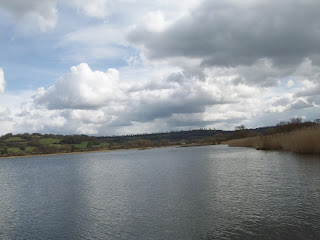


 From here we headed to Meikle Loch, where frankly I didn't expect to see much. I was wrong in my prejudgement. Shortly after we arrived a flurry of wildfowl took to the air. Amongst them I spotted ia big, sandy coloured bird with hugely prominent white wing bars. My initial reaction was 'What the hell?!', but I soon regained my senses and discovered what species I was seeing. It was an Egyptian Goose. It was sort of extraordinary when I latched onto this bird, as I have never seen one in Aberdeenshire before, let alone on the Ythan Estuary or Meikle Loch. There was no mistaking it, and was too big/sandy coloured for it to be the other wildfowl species that has prominent white wing bars - Ruddy Shelduck. It's head was also too pale for Ruddy Shelduck and I could see a shade of green towards the wing. Annoyingly, it flew some way from its originally location on the Loch and landed in the fields behind. Here it annoyingly went of view. However, a few minutes later it flew back onto the Loch, sticking at the very back. This meant views weren't all that satisfactory, but through the scope you could easily see that it was an Egyptian Goose. It stayed near the back of the Loch for another few minutes and then flew off completely, heading south-east. What a strange bird to see! When it had disappeared, my mind puzzled as to why this bird was in North-east Scotland and of its origins. Was it a bird that was part of the established stronghold of Egyptian Geese in southern England and had migrated up to Scotland? Was it an escape? I doubted the latter, as it was incredibly flighty and only stayed on the Loch for about 10 minutes. Later that day I reported the bird on Birdguides and Birdforum and my Dad on ABZ Rare Birds. Just today, I got a response from an aberdeenshire birder on Birdforum who told me that the only other record of Egyptian Goose in North-east Scotland ever was a bird at New Deer in 2009. He told me that this possible made the sighting very significant, which makes me feel quite excited. On the other hand, he did mention that it is hard to know whether the credentials of such a bird would be suitable for one of the birds from the established strongholds in Norfolk and southern England. Having checked Birdguides I have noticed that an Egyptian Goose was seen last week in Shetland, so I'm half inclined to think that it may be the same bird that was seen in Shetland. However, it could also be one of the birds from a small stronghold in the Gosford Estate, Lothian. These are just possibilities. Its actual origins still remain clouded in ambiguity... My Dad and I aren't the only people to have seen it, as one person reported that it was seen on the Estuary itself an hour and a half after we'd seen it fly off. It hasn't been seen since, as far as I'm aware. An interesting one... I did year tick it, which now means that my year list is on 131 species.

 Now that really is all I'm going to post in here until I get back from Portland! I hope I have a lot to report to you, as I'll be going to several places in Dorset, Hampshire and on the first part of my holiday, Somerset. Before I go to Portland I'm going to be spending a week in Somerset with family. On one day (maybe next Saturday) I hope to go to Chew Valley Lake, where Ferruginous Duck and Lesser Scaup have been seen recently, and on the other day I hope to go to Ham Wall/Shapwick Heath where a Great White Egret has been seen recently. When staying in Portland it is likely that I'll spend quite a bit of time in the areas round the observatory, but I will almost certainly visit places like Ferrybridge, Portland and Poole Harbour, Arne RSPB, Radipole Lake and Lodmoor RSPB. I may also visit places in Hampshire if Portland is quite quiet (for example Blashford Lakes). I have got my target birds for the trip, but I won't mention these to you until I get back. Anyhow, I'm leaving for England on Tuesday. I'm immensely looking forward to staying in Portland, and hopefully will enjoy reporting back my trip in here.

 As the Great Grey Shrike was more distant now we decided we’d leave it be for a while and head in search of a speciality species that was known to be present in the area – Black Grouse. Now, Black Grouse has always been a species that I have never seen, solely because hitherto my trip into the Rhynie area I had never been anywhere that was fairly reliable for them (yes I haven’t given the Highlands proper justice!). However, now was my chance to connect with this wonderful species. With Fiona hopping into our car, we left the car park, took a turn off and headed down a road in which she said she had seen Black Grouse before. A little way down this road she told us to park up and scan the moors. We did so, waiting patiently and looking meticulously for any medium-sized, sturdy gamebird that decided to venture behind the boggy grass that dominated in front of the tall heather behind. 10 minutes pass... no sign of any Grouses, but a few Curlews and Lapwings. Another 5 minutes pass and there is no change. But wait! Just as we were thinking that we may have to move on a little, I spot the back of a black coloured, medium sized bird behind a piece of bog. I stare through the scope fixatedly at it, and alert Fiona and my Dad of it. I was almost certain it was a Black Grouse, but for confirmation’s sake I needed it to appear from behind the bog. It did so, and there before me stood an astounding male Black Grouse. My reaction as it appeared was one of complete and utter joy. It was a beautifully ornate bird, with an almost fully jet black body. Going down its neck I noticed it had an exquisite, glossy green blue sheen and I could see its blood red, comb-shaped eyebrows, the latter feature being akin to that of the Red Grouse but much more vibrant looking and noticeable. It was an absolutely tremendous looking bird. As I watched flabbergasted at the beauty of the Black Grouse, my Dad pointed out that he had spotted another male not far to the right of the one which I was watching. Zooming out a little on the scope, I managed to get both birds into my field of vision. The one which I had originally been watching was busily feeding, whilst the other was just standing there. It felt almost like a dream to watch them, as not only is Black Grouse my favourite grouse species but one of my favourite birds. They were divine. After about 5 minutes of watching them, they suddenly took to the air. This was a stupendous sight, and I couldn’t help noticing their prominently exposed, long, lyre-shaped tails. I could also clearly see the white flash of the birds’ underwings and wing-bars, which were outstanding due to the darkness of the rest of the birds’ body. Unfortunately, they didn’t stay in flight briefly or not flight far. Instead, they flew completely out of sight. What extraordinary birds!
 Arriving back, we found the Great Grey Shrike back on the perch in which we had originally seen it. I proceeded to look at it through the scope, trying to take a few pictures but failing to do so. Just as I was trying to take a picture, a van pulled up beside us, and out of it came a man with binoculars in his head and a young girl also surprisingly with binoculars. Who could this be? Well, the man seemed to know who I was.


 ck. Scaup had managed to elude me last year, so it was a nice feeling to catch up on this species again. As we were watching the Scaup, a familiar, diagnostic high pitched, short whistling call came from close by. Taking our eyes off the Scaup, we turned to see 2 fantastic Kingfishers zipping away from us across the Loch, leaving a glint of azure as they passed. These beauties never fail to impress me. After about 30 seconds they went out of sight, and we left the Scaup to continue the final quarter of our walk. On this final quarter there wasn't much of note, but we spent quite a bit of time admiring the commoner ducks, each with their assortments of multi-coloured plumages. It looked as if a lot of the ducks plumages had been finely painted on them... its just something to watch ducks, whatever species. Undoubtedly one of my favourite families of birds. The walk round the Loch had taken just under two hours, and I must say was a very enjoyable one, even though we missed out on Black-throated Diver and White-fronted Goose. We had managed two of the species, as well as 3 year ticks that I hadn't expected in the form of Goldcrest, Siskin and Kingfisher. In total, there were 5 year ticks, meaning after this trip the year list was up to 113 species. As well as managing to see some nice year birds, it was a lovely walk anyway. I also really liked the contrasting habitats, the abundancy of the ducks on the Loch, and how well the ducks were showing. It was fantastic. On the way back towards Aberdeen, we stopped off at Montrose Basin to give it a small check. However very few birds were present close to the hides, and considering the size and length of the Basin, those birds that were on it were a very long way off. The most notable species here was 3 Little Grebes. We were back in Aberdeen in time for a nice cuppa.


 So that my friends, is me FINALLY up to date. I can now post things quickly after they take place, rather than talk about birding days that took place a month or more before! With that, you can also expect quite a lot of my posts to be quite a bit shorter, unless the day in which I'm writing about is a fantastic one. On Sunday, I should be going out birding, so expect a post then or a couple of days afterwards if not. Next month, I will be staying in Portland, which will probably the next major thing I write about in here, and in May I will be going to Norfolk. So in the coming months I should still have a lot to write about and a lot to see! Stay tuned if you wish to keep up to date with my birding adventures.