 As I looked out to sea I quickly came to the conclusion that not a great deal was passing offshore, although there was a steady and fairly substantial passage of Common Scoters, flying in flocks of 3 or more. After a refreshing cuppa and some hobnobs, we decided to have a check of the Obs garden and go down to the Bill again as nothing of note was being seen from the Observatory itself. From Martin’s report I wasn’t expecting to see any signs of fall conditions. I was annoyingly correct in my expectations too, as despite a meticulous check of the Obs garden there were no signs of any of the scarcer species that had been present the previous day; not even any Redstarts. Maybe 20 each of Willow Warbler and Chiffchaff remained, but this was a significant decrease from yesterday’s numbers. One word was lingering in my mind, and that word, I thought, could well turn out to prophesise the rest of the day’s birding on Portland; quiet. What can one do though? Admittedly I was taken aback slightly by the sudden change from the previous evening (the change from definite signs of a fall and huge numbers of small birds, to very little indeed), but Portland is obviously one of those places that is dependent on certain winds and weather conditions for providing good birds. On the plus side, I was still very keen to explore other parts of the island, I could always go elsewhere and things could change. As I walked down to the Bill the atmosphere of the morning livened up a little as I discovered that the White Wagtail was still present, feeding busily with a few Pied Wagtails just a few paces away from the end of the huts round the Obs garden. As well as this I was delighted to come across 3 cracking male Wheatears flitting about on the rocks by the shore, their white rumps leaving me in a state of trance and allowing me to ID them instantly. These 3 birds were my first of the year and took the year list up to the big 150 mark. When we got to the Bill itself and had a look again out to sea much the same was passing, basically more Common Scoters plus a few Razorbills and Guillemots. Apart from that though, there really was very little happening, so we trudged back to the Observatory. Our entire walk and check of the Bill and the Obs garden took just over an hour, so by the time I returned to the Observatory it was coming on 8:00am. The sun was well up by now, shining high in the sky and casting an air of warmth on the area; it looked like it was going to be a lovely day. The atmosphere of the day birding wise remained negative though. Little did I know though that I was going to be in for a pleasant surprise when I got back into the Observatory...
I have to confess to being very hungry when I got back, and I decided to disregard birding for a while just so I could have some breakfast... toast had rarely felt as replenishing as it did then. Now for those who aren’t aware of this, a lot of ringing goes on in Portland, and every 20 minutes Peter will go around usually with a few visiting ringers and check if any birds have been caught in the nets. They leave the nets up from dawn till dusk, and anything that gets caught in them is taken out of the nets and is ringed (if the bird hasn’t been ringed already). Once ringed, if the bird is of the scarcer variety they will bring it up and show them to visitors in the hand, although sometimes I was told that they do bring up commoner migrants like Chiffchaffs, Willow Warblers, Whitethroats and Blackcaps. I was yet to see a bird in the nets or being taken up to the veranda, so when I noticed people getting off their seats and stopping staring out to seas and going towards Peter, I knew that something had been caught, ringed and was going to be shown to visitors. The question was which species? With me noticing this, I left my toast and hurriedly joined everyone on the veranda. As I did so I could see Peter walking towards us with a bird in his hand, from a distance looking like a Phyllosc. I wasn’t able to see quite where it was from that distance, but as he got closer I could see that it was far too small (minute) to be a Phyllosc and that it had a bright, orange crest. As he climbed the stairs I could see a whacking great supercilium... It was a male Firecrest!


 You can’t see it on the map above, but Suckthumb is situated between the small communities of Weston and Southwell. The quarry itself mines the famous Portland Stone, a type of limestone mined only on the Isle of Portland that has been used since Roman times and is the stone to have built several famous buildings such as Buckingham Palace and St Pauls Cathedral in London. We had been told that Hoopoe had been favouring some fields on the very edge of the quarry, pecking around by some horse paddocks. We were given precise directions as to how to easily access these fields, and were there by 9:45am. Parking up just as the fields came into view, we got out of the car and proceeded to enter the quarry. I set up the scope and scanned the whole field as meticulously as I could whilst Dad scanned through the bins. A few Pied Wagtails were scuffling around, along with at least 5 Wheatears (2 females and 3 males), which was quite nice. The Hoopoe, however, was conspicuous by its absence. There just wasn’t one there. Hmm, what to do... The best thing was just to have a look around the whole quarry for it, plus check for anything else. The bushes looked ideal for catching a fall or a rare passerine, but it was by no means the right conditions for this. We trudged round the quarry, sweating as the heat of the day intensified, with no success. The best that Suckthumb Quarry had to offer bird-wise was those Wheatears plus 2 migrant Willow Warblers. I wasn’t surprised that we had failed to see the Hoopoe. After all it was bound to have moved on due to the lovely weather and clear skies. Having done this, we decided it would be most appropriate to head to Radipole Lake RSPB, not far as it was only in Weymouth. There had been an Alpine Swift around there a few days before. Plus, Portland was destined to be quiet all day with the sheer lack of migrants passing through. We didn’t plan to go towards the Poole Harbour until the next day, so birding locally seemed to be the best idea. A couple of pictures taken at Suckthumb Quarry are below.
 It took surprisingly long to get from Suckthumb Quarry to Radipole Lake, with traffic acting as a constant hindrance to our birding time (WARNING: The traffic is terrible in Weymouth). It probably took around 25 minutes to half an hour to get there, plus time spent getting food for the day. When Radipole came into view I couldn’t help but think about how strange its location was, a lake fringed by dense reedbeds in the heart of hectic Weymouth; convenient for those living locally, definitely. On our arrival we paid at the car park, and headed off for a look around. The species I was most wanting to see here was Bearded Tit, a specialist bird to the reserve and a bird that is very hard to see here in NE Scotland (although they are just about annual at Loch of Strathbeg but very elusive). I was also looking for Reed Warbler (even though it was a bit early for them), yet another bird that you don’t get in North-East Scotland. I had seen both species on plenty of occasions before, but to see them both would be very useful on the year-list front. As we crossed the bridge to enter Radipole I couldn’t help but notice the escaped Hooded Merganser hanging around and feeding with the Mallards in its semi-tame fashion, and decided to photograph it just because it was an aesthetically pleasing creature. See below for a photo. If it only it was wild... hey?
 Looking out from the other side of the bridge, there were a variety of species of commoner ducks, ranging from Shelduck to Gadwall, as well as a couple of Little Grebes and plenty of Black-headed Gulls. I quickly felt the need to get away from the general populous and thus headed onto the reserve quite quickly. It wasn’t long before we heard the explosive song of a Cetti’s Warbler, and it wouldn’t be the last time we’d hear it, as there were plenty around on the reserve. A Sedge Warbler was also singing nearby to where we had heard our first Cetti’s. It was rather pleasant walking around and being surrounded by reedbeds in the sunshine and hot weather, a far more tranquil scene than the hecticness of the car park. As we walked towards the North Hide I had fleeting views of at least 3 Cetti’s Warbler, with one individual briefly hanging onto a piece of reed very close to us before flitting out of view. A few more Sedge Warblers were singing and one was seen. However, despite meticulously searching for them, there weren’t any signs of Bearded Tits. I found this somewhat odd as I had the impression that there were a good number of Bearded Tits on the reserve. Furthermore, I hadn’t even heard any. On a couple of occasions we came to openings in the reedbeds and had a look for avifauna, but there was nothing apart from the same variety of wildfowl that we had seen earlier on. The word was once again staring me in the face - ‘Quiet’. Mind you, what do you expect? There is minimal wind, the skies are clear and it’s hot! When we finally reached the North Hide, which was quite a walk, we had a look out. After sitting there for 20 minutes we had seen much of the same, which was perfectly nice but was not enough to keep us fully occupied. As I sat there, staring out onto the reedbed fringed lake, I felt slightly soporific. The fact that I had only had around less than 8 hours that night was starting to tell on me, and I was feeling somewhat tired. As was my Dad, so we headed back to the car park to have something to eat and drink to fuel us up, yet again failing to hear or see any Bearded Tits. I now knew that seeing Bearded Tits at Radipole wasn’t as easy as I had originally thought. My overall impression of Radipole was that it was a nice reserve and could easily have potential when conditions were better; however it was a little too disturbed for my liking.

Langton Herring itself is a beautiful little village, and to access where the Hoopoe was hanging around you have to park at the end of the village and walk down through rolling fields towards the coastguard’s cottages by the beach. The field that the Hoopoe had been favouring was in fact before you reach the coastguard’s cottages, on the edge of the only oil seed rape field in the area. It took us a little while to find where we were supposed to be going to get into the area, but with the help of a birder (who unsurprisingly said that he hadn’t seen it) we found out where to go and proceeded to walk down. The area itself was very scenic, the ideal place to spend a sunny afternoon. When we reached the rape field, we walked slowly down the edge of it, seeing if we could flush up anything orange. But no, it wasn’t to be, as I had expected. Once we had walked down the side of the whole field we came to a lagoon, situated in front of the beach. It held a few species of wildfowl, the commoner suspects and, on the more notable side, at least 6 Red-breasted Mergansers. A Little Egret also flew by. Yet again though, it was quiet. With the feeling of quietude and being soporific, my Dad and I couldn’t help but just sit there and relax for a while, admiring the beauty of the area. After a while we moved on, slowly wheeling round past the coastguard’s cottages and back up the track towards the car, with still no sign of the Hoopoe. Not that I felt at all disappointed though, I wasn’t expecting to see it by any means. From here we couldn’t really think of much else to do or anywhere else to go. It was nearing 4:30pm, and we were both feeling tired. We both agreed that we might as well go back to the Observatory. Below is a picture of Chesil Beach.
 And we did return to the Observatory, to find out that nothing but a few more Chiffchaffs, Willow Warblers and Blackcaps had been ringed. Nothing new had been seen apart from that. Dad was more tired than me, and shortly after we arrived back he had a kip. I had a brief look around the Obs garden, but with little success, the best I could see being a few Chiffchaffs and Willow Warblers. At this point, I gave up for the day, and woke Dad up. We spent the rest of the day sitting in the Observatory chatting to other birders, and as it got dark, went to the local pub with one of the birders and the ringer Peter. Overall, a very quiet day, which was frankly rather disappointing, what with the fall on the previous day. However the Firecrest was lovely. Without that, it could have been even worse. Not the ideal start for the holiday, but there was room for improvement. The next day we would spend the day in Poole Harbour, which we hoped would prove more productive. Whether it would or not is a story yet to be told. For more on that, tune in to my next post.
Thanks for reading,
Joseph


 It was a small hop down to Moreton Point, but finding the hide here proved quite difficult. We presumed there would be a small turn off for it. There was, but first time round we somehow managed to miss it. In realisation, we turned back and due to more focus we soon found a small turn off down a track which said: to Moreton Hide. As we travelled down the track, my Dad noticed a large corvid sitting on top of a dead tree. Getting our bins onto it, we discovered that it was a Raven, being way to thick billed and bulky for a commoner crow and my first one of the year. Shortly after this unexpected encounter, we reached the small car park and found the hide with relative ease, which to our surprise was empty. Opening up the shutters, we quickly found a group of Tufted Ducks about 50ft away from us, and set out to scan them for one of the rarer ducks that we were pursuing. Almost every duck was a Tufted Duck except one small, grey backed and non-tufted individual. There it was, the Lesser Scaup! You couldn't mistake it. It was way too small for a Greater Scaup and was even smaller than the Tufted Ducks that it was beside. Checking birdguides we found that it hadn't been reported thus far, so I put it in at speed. As well as being told by its small sized, this cracking drake Lesser Scaup also had a small crest-like crown peaked at the rear of its head and darker which lacks on a Greater Scaup and a coarser, darker grey vermiculation than its commoner cousin. It showed absolutely superbly, feeding and drifting casually with the 20 Tufties that it was with and diving every few minutes. I noticed a lot of the time that it had a habit of hanging its head very low and close to the water, which a Greater Scaup rarely does. Even when it did straighten itself up, it was visibly smaller than the Tufties. The other thing that struck me about this bird was that it spent quite a lot of the time hanging around with a female Tufted Duck, and at one point tried to peck at her as if it were attracted to her. It seemed to me that it almost thought it was a Tufted Duck or that it was with a group of Lesser Scaups, as if it wasn't aware that it was a different species from the others. As the Tufted Duck group moved, it moved, and the closest the flock got was around 35ft from the hide. Even at a further distance I managed to get some ok photos of it. It was fantastic to see this Lesser Scaup, as the views were ideal and also it seemed that we were the first people to have come across it that day. Here are a few pictures that I got of this beauty of a bird and a view out from Moreton Hide (note that in every picture the Lesser Scaup is the smallest bird):


 After about 15 minutes of watching the Lesser Scaup we were joined in the hide by a few of the local birders who were happy to know that it was still around. We watched it with them for another half an hour or so, enjoying very nice views of it. Whilst the locals were there we asked them to tells us how to get to the nearby Stratford Hide (which looks out over Stratford Bay), and after 3 quarters of an hour of watching the Lesser Scaup we decided that we were going to go there. At the same time we found out that no-one had seen the Ferruginous Duck there, but hope wasn't lost as it could still be anywhere on the Lake. After a nice walk in the sunny weather, we arrived at Stratford Hide. It was a perfectly placed hide, sticking some way out into water (hence why there was a boardwalk to it) and allowed for fantastic views of the wildfowl. Tufted Ducks, Great-crested Grebes, Coots and Pochards all came with no more than 12ft of the hide. It was great to see them all so close up without even having to use binoculars. As the birders at Moreton Hide had said, there was no Ferruginous Duck amongst the multitude of common duck species, but it was nice to just sit there for quarter of an hour having a late lunch looking out across the Lake and watching the wildfowl come very close to me. Once we had finished our lunch, we walked back to where we'd parked the car near Moreton Hide and headed to the next place along, Herriot's Pool. Here is a picture of Chew Valley Lake taken from Stratford Hide: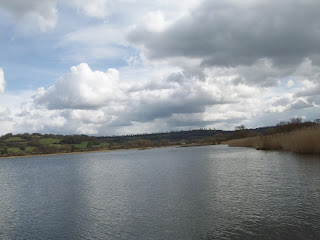


 From here we headed to Meikle Loch, where frankly I didn't expect to see much. I was wrong in my prejudgement. Shortly after we arrived a flurry of wildfowl took to the air. Amongst them I spotted ia big, sandy coloured bird with hugely prominent white wing bars. My initial reaction was 'What the hell?!', but I soon regained my senses and discovered what species I was seeing. It was an Egyptian Goose. It was sort of extraordinary when I latched onto this bird, as I have never seen one in Aberdeenshire before, let alone on the Ythan Estuary or Meikle Loch. There was no mistaking it, and was too big/sandy coloured for it to be the other wildfowl species that has prominent white wing bars - Ruddy Shelduck. It's head was also too pale for Ruddy Shelduck and I could see a shade of green towards the wing. Annoyingly, it flew some way from its originally location on the Loch and landed in the fields behind. Here it annoyingly went of view. However, a few minutes later it flew back onto the Loch, sticking at the very back. This meant views weren't all that satisfactory, but through the scope you could easily see that it was an Egyptian Goose. It stayed near the back of the Loch for another few minutes and then flew off completely, heading south-east. What a strange bird to see! When it had disappeared, my mind puzzled as to why this bird was in North-east Scotland and of its origins. Was it a bird that was part of the established stronghold of Egyptian Geese in southern England and had migrated up to Scotland? Was it an escape? I doubted the latter, as it was incredibly flighty and only stayed on the Loch for about 10 minutes. Later that day I reported the bird on Birdguides and Birdforum and my Dad on ABZ Rare Birds. Just today, I got a response from an aberdeenshire birder on Birdforum who told me that the only other record of Egyptian Goose in North-east Scotland ever was a bird at New Deer in 2009. He told me that this possible made the sighting very significant, which makes me feel quite excited. On the other hand, he did mention that it is hard to know whether the credentials of such a bird would be suitable for one of the birds from the established strongholds in Norfolk and southern England. Having checked Birdguides I have noticed that an Egyptian Goose was seen last week in Shetland, so I'm half inclined to think that it may be the same bird that was seen in Shetland. However, it could also be one of the birds from a small stronghold in the Gosford Estate, Lothian. These are just possibilities. Its actual origins still remain clouded in ambiguity... My Dad and I aren't the only people to have seen it, as one person reported that it was seen on the Estuary itself an hour and a half after we'd seen it fly off. It hasn't been seen since, as far as I'm aware. An interesting one... I did year tick it, which now means that my year list is on 131 species.

 Now that really is all I'm going to post in here until I get back from Portland! I hope I have a lot to report to you, as I'll be going to several places in Dorset, Hampshire and on the first part of my holiday, Somerset. Before I go to Portland I'm going to be spending a week in Somerset with family. On one day (maybe next Saturday) I hope to go to Chew Valley Lake, where Ferruginous Duck and Lesser Scaup have been seen recently, and on the other day I hope to go to Ham Wall/Shapwick Heath where a Great White Egret has been seen recently. When staying in Portland it is likely that I'll spend quite a bit of time in the areas round the observatory, but I will almost certainly visit places like Ferrybridge, Portland and Poole Harbour, Arne RSPB, Radipole Lake and Lodmoor RSPB. I may also visit places in Hampshire if Portland is quite quiet (for example Blashford Lakes). I have got my target birds for the trip, but I won't mention these to you until I get back. Anyhow, I'm leaving for England on Tuesday. I'm immensely looking forward to staying in Portland, and hopefully will enjoy reporting back my trip in here.

 As the Great Grey Shrike was more distant now we decided we’d leave it be for a while and head in search of a speciality species that was known to be present in the area – Black Grouse. Now, Black Grouse has always been a species that I have never seen, solely because hitherto my trip into the Rhynie area I had never been anywhere that was fairly reliable for them (yes I haven’t given the Highlands proper justice!). However, now was my chance to connect with this wonderful species. With Fiona hopping into our car, we left the car park, took a turn off and headed down a road in which she said she had seen Black Grouse before. A little way down this road she told us to park up and scan the moors. We did so, waiting patiently and looking meticulously for any medium-sized, sturdy gamebird that decided to venture behind the boggy grass that dominated in front of the tall heather behind. 10 minutes pass... no sign of any Grouses, but a few Curlews and Lapwings. Another 5 minutes pass and there is no change. But wait! Just as we were thinking that we may have to move on a little, I spot the back of a black coloured, medium sized bird behind a piece of bog. I stare through the scope fixatedly at it, and alert Fiona and my Dad of it. I was almost certain it was a Black Grouse, but for confirmation’s sake I needed it to appear from behind the bog. It did so, and there before me stood an astounding male Black Grouse. My reaction as it appeared was one of complete and utter joy. It was a beautifully ornate bird, with an almost fully jet black body. Going down its neck I noticed it had an exquisite, glossy green blue sheen and I could see its blood red, comb-shaped eyebrows, the latter feature being akin to that of the Red Grouse but much more vibrant looking and noticeable. It was an absolutely tremendous looking bird. As I watched flabbergasted at the beauty of the Black Grouse, my Dad pointed out that he had spotted another male not far to the right of the one which I was watching. Zooming out a little on the scope, I managed to get both birds into my field of vision. The one which I had originally been watching was busily feeding, whilst the other was just standing there. It felt almost like a dream to watch them, as not only is Black Grouse my favourite grouse species but one of my favourite birds. They were divine. After about 5 minutes of watching them, they suddenly took to the air. This was a stupendous sight, and I couldn’t help noticing their prominently exposed, long, lyre-shaped tails. I could also clearly see the white flash of the birds’ underwings and wing-bars, which were outstanding due to the darkness of the rest of the birds’ body. Unfortunately, they didn’t stay in flight briefly or not flight far. Instead, they flew completely out of sight. What extraordinary birds!
 Arriving back, we found the Great Grey Shrike back on the perch in which we had originally seen it. I proceeded to look at it through the scope, trying to take a few pictures but failing to do so. Just as I was trying to take a picture, a van pulled up beside us, and out of it came a man with binoculars in his head and a young girl also surprisingly with binoculars. Who could this be? Well, the man seemed to know who I was.


